
more Mainstream Apologetics ...

Evidence ID: HIS-EV53
Evidence: Roman Scourging Details Unknown Before Fourteenth Century
Summary: Details of the Roman flagrum were unknown until one was unearthed in the ancient Roman city of Herculaneum in 1709. This discovery post-dates the fourteenth century when the Shroud of Turin was allegedly forged. The scourge marks on the Shroud of Turin are consistent with the dumbbell-shaped tips found on the Roman flagrum. Further, the halo marks from the metal tips of the flagrum are only visible using ultraviolet light.
Description:
Historical records suggest that Roman scourging was a standard part of Roman judicial practices from the early Republic period (around 5th century BC) until the decline of the Roman Empire in the 4th century AD. This practice was designed to administer enough lethal blows to cause the most damage to the victim's body, yet not enough blows to kill them. Roman scourging was perfected over the centuries to inflict excruciating pain while torturing their victims to near-death.
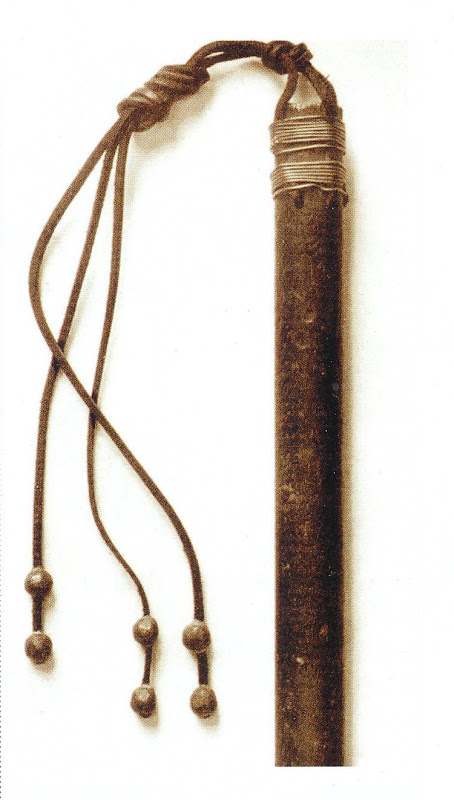
Precise details of the Roman flagrum were unknown until one was unearthed in the ancient Roman city of Herculaneum in 1709 [REF-HER01]. This discovery post-dates the Fourteenth century when the Shroud of Turin was allegedly forged [HIS-IS42]. The discovered Roman flagrum consisted of a wooden handle, three leather thongs and metal balls at the end of each thong. These metal objects were arranged in the shape of a dumbbell or plumbatae.
A replica of the unearthed Roman flagrum from the city of Herculaneum is depicted below.
In Stephen E. Jones' commentary on the Shroud of Turin [REF-SOT03], he cites:
"Each one of the over 100 scourge wounds on the Shroud matches exactly what would have been caused by a type of Roman flagrum buried in the eruption of Mount Vesuvius in 79 AD. So a fourteenth century or earlier forger would have had to possess a faultless archaeological knowledge of a first century Roman scourging with a flagrum as well as make no normal artists' mistakes since each one of the over 100 scourge marks has identical dimensions. Only from the Middle Ages did artists depict the scourging of Jesus and even the best of them were vague about the details. But the scourge-marks on the Shroud are depicted with a realism that is unknown to the art of any period."
Evidence of the dumbbell-shaped scourge wounds are readily visible on the shroud image depicted below.

Further evidence from the shroud suggests that there were two lictors (scourgers) who administered the lethal blows. Based on the angle or goniometry of the plumbatae wounds, there was a lictor on each side of Jesus. The rationale for two lictors, as opposed to one, is that two could administer an equal number of wounds on each side and front of the victim's torso [REF-SOT08].
Regarding the dumbbell-shaped scourge wounds on the shroud, Jones also cites:
The scourge marks on the Shroud are physiologically accurate. When examined under a microscope, each scourge mark reveals a slightly depressed center and raised edges. Under ultraviolet light each scourge mark can be seen to have a "halo" of lighter colour surrounding it. These halos were chemically tested and found to be blood serum which is left behind after a blood clot forms and then retracts inwards as it dries, a process called syneresis. These scourge mark indented centres and raised edges on the Shroud are not visible to the naked eye, but can only be seen when examined under a microscope and the serum halos can only be seen under ultraviolet light. This is further evidence that the Shroud could not have been created by an artist in the Middle Ages, or earlier, because that knowledge about blood clot structure, let alone a microscope and an ultraviolet light source to see it, did not then exist for many centuries into the future."
According to forensic pathologist Frederick Zugibe, "scourging reduced Jesus to an exhausted, mangled mass of flesh and propelled Jesus into an early stage of hypovolemic shock" [REF-FTZ01]. Zugibe further observed that the absence of scourge marks on Jesus' arms suggests that his arms were elevated above his head allowing the thongs of the flagrum to completely encircle the torso impacting the front of Jesus body without being impeded. This slumped position is depicted in the following figure.

There is further visual evidence that the images of blood serum above Jesus' shoulder blades were smeared due to carrying the patibulum (crossbeam) on the way to Golgotha.
Since details of the Roman flagrum and the discovery of ultraviolet light were unknown to a Fourteenth century forger, the Shroud of Turin must be genuine.
* For more Shroud of Turin evidence regarding Jesus' death and resurrection, please visit the following: [HIS-EV39] [HIS-EV38] [HIS-EV52] [HIS-EV54] [HIS-IS42].
Resources:
Copyright@2026 Mainstream Apologetics